When Can Jews Get Married? A Guide to the Jewish Wedding Calendar
By SimchaMaker
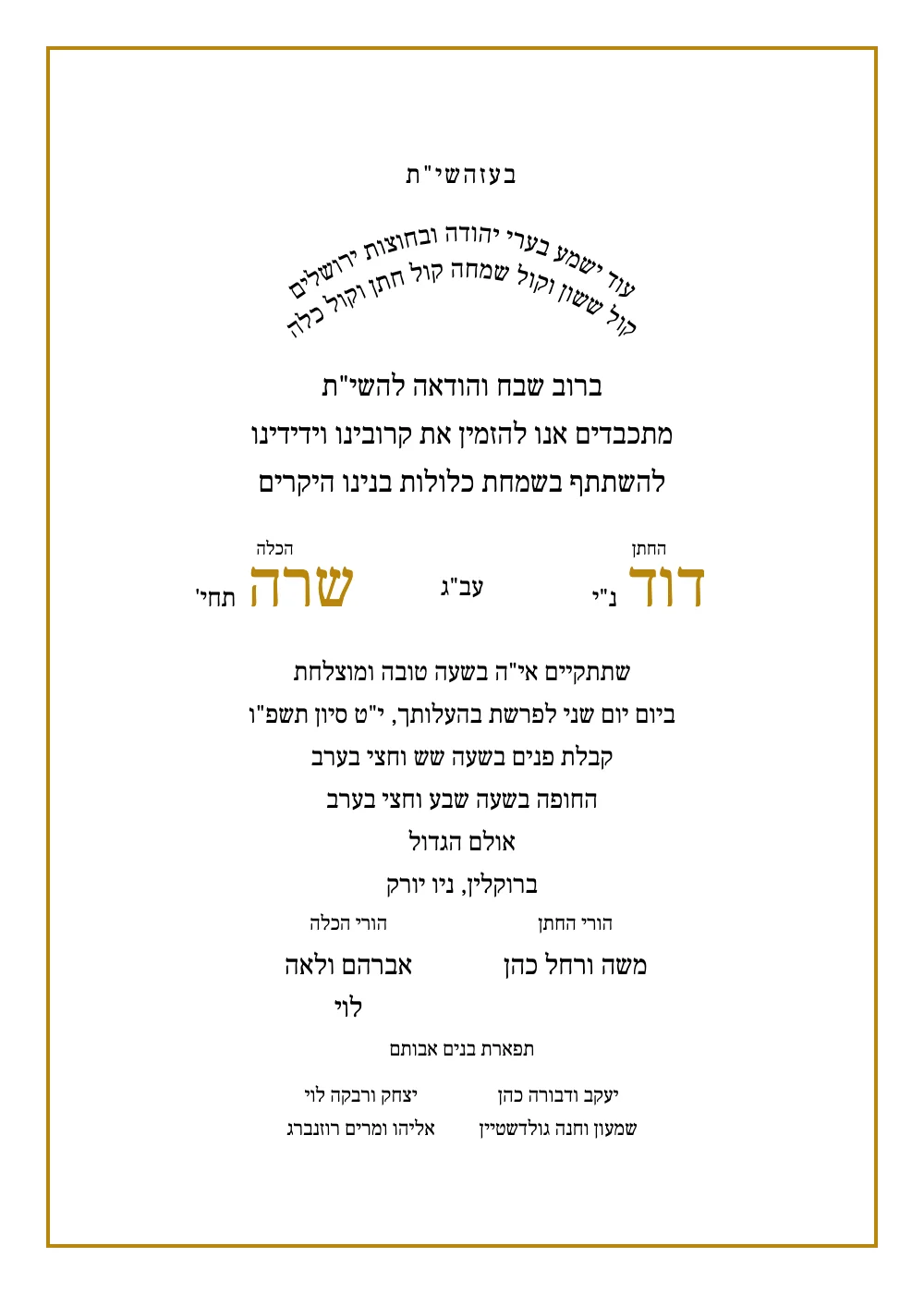
Choosing a Jewish wedding date is not quite as simple as finding a Sunday when the hall, band, photographer, and your entire extended family are available.
The Jewish calendar gets a vote too.
Some dates are unavailable because of Shabbat or Yom Tov. Some fall during traditional periods of mourning when weddings are not held. And then there are dates that are perfectly acceptable in one Jewish community but avoided in another.
That last category is where things get interesting.
Ask three observant families whether you can make a wedding a few weeks after Pesach and you may get three different answers. All three may be following legitimate Jewish customs.
Rather than trying to create a single list of “approved Jewish wedding dates,” it is more useful to divide the calendar into three categories:
- Dates when weddings generally do not take place
- Dates whose status depends on family or community custom
- Dates that may be permitted but come with practical or religious complications
And there is a fourth question that has fascinated Jewish couples for centuries: are some permitted dates actually better than others? As we will see, Jewish sources have something to say about that too.
Important: Jewish wedding customs vary between Ashkenazi, Sephardi, Chassidic, Yemenite, and other communities, and even within those broad groups. This guide explains common rules and customs, but it is not intended to decide a particular couple’s halachic question. Before signing contracts or placing a nonrefundable deposit, confirm your date with the rabbi who will be involved in the wedding.
The Jewish Wedding Calendar at a Glance
The details matter, and each of these gets its own section below. But this is the shape of the calendar most couples are working with.
| Date or period | Wedding? | What it depends on |
|---|---|---|
| Shabbat | No | A fixed rule, not a custom |
| Yom Tov | No | A fixed rule, including the second days outside Israel |
| Chol HaMoed | No | We do not combine one celebration with another |
| Motzaei Shabbat | Yes, but see below | How late Shabbat ends, plus a Shabbat-preparation concern some authorities raise |
| Friday | Yes, with care | The season, and preparing the feast in advance |
| Sefirat HaOmer | Depends | Which Omer custom your families follow |
| Lag BaOmer | Depends | Community minhag. Many Sephardim wait until the morning of the 34th day |
| The Three Weeks | Depends | Ashkenazi and several Sephardi customs restrict from 17 Tammuz; other Sephardi customs from Rosh Chodesh Av |
| The Nine Days and Tisha B’Av | No | Every custom |
| Minor fast days | Contested | Most poskim restrict the daytime; some permit the night at the start of the date, before the fast begins |
| Chanukah | Yes | Mostly a question of when everyone is lighting |
| Purim | Yes | Permitted, but it is already a full day |
| Tu B’Av | Yes | No special halachic status, but an old association with marriage |
The Simplest Rule: No Wedding on Shabbat
A traditional Jewish wedding does not take place on Shabbat.
The Mishnah specifically lists betrothal among the acts that may not be performed on Shabbat or Yom Tov. In today’s ceremony, kiddushin is the part in which the groom gives the bride the ring and recites the formula that establishes the marriage. See Mishnah Beitzah 5:2.
That part is straightforward. The more interesting question is what happens immediately before and after Shabbat.
Can You Have a Jewish Wedding on Saturday Night?
Yes, once Shabbat has ended.
Motzaei Shabbat weddings are especially common during the winter, when Shabbat ends early enough to leave time for the venue and vendors to prepare.
In the summer, things become more difficult. If Shabbat ends late, the wedding may have to start very late as well, particularly when the families, caterer, musicians, photographer, and other participants are observing Shabbat.
There is also a halachic consideration, and it is one most couples have never heard. The Gemara discusses a concern about marrying at the conclusion of Shabbat, out of a worry that preparations for that night’s feast would be made on Shabbat itself. Some authorities accordingly hold that a motzaei Shabbat wedding, while permitted, is better avoided. See the best day of the week guide for the sources.
So “Saturday night wedding” can mean something very different in December than it does in June, and it is worth raising with your rabbi rather than assuming it is the easy option.
Weddings Do Not Take Place on Yom Tov
The same Mishnah that prohibits betrothal on Shabbat applies the rule to Yom Tov as well.
That means a Jewish wedding is not scheduled on days of Yom Tov such as:
- Rosh Hashanah
- Yom Kippur
- The Yom Tov days of Sukkot
- Shemini Atzeret and Simchat Torah
- The Yom Tov days of Pesach
- Shavuot
Outside Israel, where many festivals include an additional day of Yom Tov, that naturally creates additional unavailable dates.
But what about the intermediate days of Pesach and Sukkot, when many of the restrictions of Yom Tov no longer apply?
Can You Get Married on Chol HaMoed?
Generally, no.
The Mishnah in Moed Katan states that weddings are not held during the intermediate days of a festival. The Gemara asks why, since a wedding is joyful and the festival is supposed to be joyful too.
One answer is the famous principle:
אין מערבין שמחה בשמחה
“We do not mix one celebration with another.” Each celebration deserves its own attention. The Gemara also gives other considerations, including the concern that the wedding would distract from the festival itself, and that couples might deliberately postpone marriage until a festival if the two celebrations could conveniently be combined. See Moed Katan 8b.
The rule is later codified in Shulchan Aruch, Orach Chaim 546:1, and summarized in Peninei Halakha, Chol HaMoed: Weddings.
So although Chol HaMoed might seem like the perfect time, because people are off from work, relatives are visiting, and everyone is already in a festive mood, Jewish law deliberately keeps the two celebrations separate.
The Complicated One: Weddings During Sefirat HaOmer
If you are looking for the point where a simple “Jewish wedding calendar” stops being simple, it is Sefirat HaOmer.
The period between Pesach and Shavuot is traditionally associated with mourning for the students of Rabbi Akiva. Weddings and other major celebrations are therefore restricted during portions of the Omer.
The basic custom is recorded in Shulchan Aruch, Orach Chaim 493, which notes the practice of not marrying during this period because Rabbi Akiva’s students died then. But the Shulchan Aruch and Rema themselves preserve different practices concerning exactly when those restrictions begin and end. And the story becomes even more complicated in actual Jewish communities.
Why Are There So Many Different Sefirah Customs?
The tradition establishes a mourning period during the Omer, but Jewish communities developed different customs about which days are included.
Some observe their primary restrictions during the first part of the Omer. Others observe restrictions later. Some permit weddings on Lag BaOmer. Others do not.
That means there is no single date when “Sefirah ends” for every Jewish couple.
Common Sephardi Customs
According to the practice followed by many Sephardim, weddings are not held until the morning of the 34th day of the Omer, the day after Lag BaOmer. That means Lag BaOmer itself is not automatically a wedding day under this custom.
However, Sephardi practice is not uniform. Peninei Halakha, Weddings and Engagements During the Omer Period notes that some Sephardi communities, including communities with roots in Turkey and Egypt, traditionally ended the restrictions earlier and permitted weddings on Lag BaOmer itself.
So even “What do Sephardim do?” does not have one universal answer.
Common Ashkenazi Customs
Ashkenazi practice has its own variations, and the Rema, in Shulchan Aruch, Orach Chaim 493, records two main ones.
Under the first custom, the mourning period runs from Pesach until Lag BaOmer, and weddings resume from Lag BaOmer onward.
Under the second custom, the restrictions begin after Rosh Chodesh Iyar and continue until the sheloshet yemei hagbalah, the three days immediately before Shavuot.
That second custom contains a window that couples often overlook. For a family that follows it, the days after Pesach up to and including Rosh Chodesh Iyar are available wedding dates, and so are the three days before Shavuot. A wedding in the last days of Nisan, or two days before Shavuot, is entirely consistent with that custom.
Peninei Halakha, The Ashkenazi Practice describes another widespread Ashkenazi practice in Israel in which weddings are avoided until Rosh Chodesh Sivan, while Lag BaOmer itself remains an exception on which weddings may take place. It also notes authorities and communities that permit weddings beginning after Lag BaOmer.
Some authorities also discuss whether a family may follow one of the two Ashkenazi customs in one year and the other in a different year. That is a question for your rabbi, but it is worth knowing that it exists.
The practical lesson is simple: “it’s after Lag BaOmer” does not necessarily settle the question. You need to know which Omer custom the couple follows.
Can You Get Married on Lag BaOmer?
Sometimes.
Lag BaOmer is associated with celebration and is an important break in the mourning character of the Omer. But its status as a wedding date depends heavily on minhag.
Many Ashkenazi communities permit weddings on Lag BaOmer itself. Many Sephardi communities do not hold weddings until the following morning, while some Sephardi communities traditionally do permit Lag BaOmer weddings. See Peninei Halakha, The Thirty-Third Day of the Omer.
There can even be a distinction between the night of Lag BaOmer and the daytime.
So before booking a Lag BaOmer wedding, “Lag BaOmer weddings are allowed” is not a sufficient answer. The right question is: are Lag BaOmer weddings permitted according to our family’s or community’s minhag?
Can Jews Get Married During the Three Weeks?
The Three Weeks between the 17th of Tammuz and Tisha B’Av are another period in which the answer depends partly on communal custom.
The basic sources show the distinction quite clearly.
Shulchan Aruch, Orach Chaim 551:2 states that weddings are not held from Rosh Chodesh Av until Tisha B’Av. This shorter period is commonly called the Nine Days. The Rema then adds the Ashkenazi custom of refraining from weddings beginning earlier, from the 17th of Tammuz.
That distinction is one reason simplified charts of “days when Jews cannot marry” can be misleading.
Ashkenazi Practice
Ashkenazi communities generally do not hold weddings throughout the entire Three Weeks, beginning with the 17th of Tammuz and continuing through Tisha B’Av. The Orthodox Union’s digest of the laws of the Three Weeks and Tisha B’Av likewise lists weddings among the celebrations avoided during the period.
Sephardi Practice
There is no single universal Sephardi practice.
The plain ruling of the Shulchan Aruch restricts weddings beginning with Rosh Chodesh Av, and this remains the practice in many Sephardi communities. The Orthodox Union’s Halacha According to the Sephardic Practice: The Three Weeks likewise describes Sephardic practices that begin the wedding restriction with Rosh Chodesh Av.
But other Sephardi communities are stricter.
Peninei Halakha, Marriage and Engagement during the Three Weeks notes that Yemenite Jews refrain from weddings starting from the 17th of Tammuz, that Moroccan practice follows the Knesset HaGedolah in restricting even engagements, and that most Sephardim, along with Ashkenazim, do not hold weddings during the Three Weeks.
So this is not simply:
- Ashkenazi equals the full Three Weeks
- Sephardi equals the Nine Days
The reality is more varied. That is exactly why a couple should confirm the minhag they actually follow rather than choosing a date from a generic online calendar.
What About Jewish Fast Days?
Fast days are where well-meant wedding advice tends to go wrong.
Start with a detail that drives the whole discussion: the minor fasts, Tzom Gedaliah, Asarah B’Tevet, Ta’anit Esther, and the 17th of Tammuz, begin at dawn rather than the night before. See Shulchan Aruch, Orach Chaim 550:2. The Hebrew date, however, begins at nightfall. So each fast date opens with an evening during which nobody is fasting yet, and much of the halachic discussion lives in that gap.
A wedding during the daytime of a minor fast is a genuine question, and the weight of opinion is restrictive:
- Rav Moshe Feinstein (Igrot Moshe, Orach Chaim 168) rules that a wedding may not be held during the day of the fast, but permits one on the night at the start of that date, before the fast begins.
- Chacham Ovadia Yosef (Yabia Omer, Even HaEzer 6:7) holds that a daytime wedding is technically permitted, but that it is better held on the night before or the night after.
- The Tzitz Eliezer (7:49) is stricter and does not permit even the night before.
- Rabbi Joseph B. Soloveitchik held that weddings should not be held on fast days (Nefesh HaRav, p. 196).
Halachipedia’s summary of scheduling a wedding date collects these opinions along with further sources in both directions.
So a minor fast is not a date to pencil in on the assumption that it will work out. There is a real practice of holding the chuppah on the night at the start of the fast date, before dawn, but it rests on a particular ruling rather than on a universal custom, and other authorities do not accept it. This is a date to clear with your rabbi before booking the hall.
Two of the fasts are more restricted than the rest.
The 17th of Tammuz begins the Three Weeks, so under Ashkenazi custom and the stricter Sephardi customs it is not an available date at all. The question about the preceding night sharpens here. Rabbi Soloveitchik’s position, that the character of the fast day and of the Three Weeks already begins at sundown even though the fast itself begins in the morning, is discussed by the Orthodox Union in Getting Married the Night of Shiva Asar B’Tammuz.
Tisha B’Av falls within the Nine Days and is not a wedding date under any custom.
Ta’anit Esther carries a practical complication on top of the halachic one: it falls on erev Purim.
Can You Have a Jewish Wedding on Chanukah?
Generally, yes. Chanukah does not create a general prohibition against holding a wedding.
Of course, a Chanukah wedding introduces its own logistical question: when is everybody lighting menorah? Depending on the timing of the wedding and the guests involved, that can become an important part of planning the evening.
Can You Have a Jewish Wedding on Purim?
Yes, according to the straightforward ruling of the Shulchan Aruch. This one is unusually explicit:
מותר לישא אשה בפורים
“It is permitted to marry on Purim.” The Rema adds that this applies on both the 14th and 15th of Adar. See Shulchan Aruch, Orach Chaim 696:8.
One caveat: some later authorities were hesitant about Purim weddings because of the same principle that keeps weddings off Chol HaMoed, not mixing one celebration with another. The accepted ruling permits, but it is worth a word with your rabbi.
Permitted does not necessarily mean Purim is the easiest day on which to hold a wedding. Guests may also need to hear Megillah, send mishloach manot, give matanot la’evyonim, attend or host a Purim seudah, and possibly recover from decisions made at that seudah.
So Purim is a good example of the difference between permitted and practical.
What About Tu B’Av?
Tu B’Av’s association with romance is not a modern invention.
Mishnah Ta’anit 4:8 describes the 15th of Av as one of the most joyous days of the Jewish year. On that day, the young women of Jerusalem would go out in borrowed white clothing and dance in the vineyards, while unmarried men would come to seek a wife.
That makes Tu B’Av’s modern association with matchmaking and marriage unusually well rooted in classical Jewish sources.
It does not give the date any special ability to override other halachic considerations, but for couples looking for a Jewish date with a marriage connection, Tu B’Av has a much older pedigree than most people realize.
Is There a Best Day of the Week for a Jewish Wedding?
Today a wedding can be held on any permitted weekday, so this is a second-layer question rather than a calendar restriction. It is still one most families ask.
The short version: Mishnah Ketubot 1:1 scheduled a first marriage on Wednesday and a widow’s on Thursday, for reasons of court schedules and preparation time rather than good fortune, and the Gemara permits any day once courts sat daily. Tuesday’s modern reputation comes from כי טוב, “it was good,” appearing twice on the third day of Creation, which is a beloved sign of blessing rather than a Talmudic rule. Monday is permitted like any other day, despite a widespread idea to the contrary. Sunday is the most common day in Orthodox communities today and is a matter of pure convenience, despite classical sources that restrict it. Friday and motzaei Shabbat are both permitted, and both come with a Shabbat-preparation question attached.
Because the Jewish day begins at night, a Monday evening chuppah is already Tuesday, and a Saturday night one is already Sunday.
Read the full guide to the best day of the week for a Jewish wedding for the sources behind each of these, including the Talmud’s own and rather darker explanation of how Tuesday weddings began.
Remember: the Jewish Date Begins at Night
This sounds obvious once you know it, but it causes real scheduling mistakes. A civil calendar date changes at midnight. A Jewish calendar date changes at night.
That means a wedding at noon on a Tuesday and a wedding at 8:00 p.m. that same Tuesday can take place on different Hebrew dates.
This becomes especially important when a restriction begins or ends on a particular Jewish date. If you are trying to determine whether a wedding falls during Sefirat HaOmer, Lag BaOmer, the Three Weeks, a fast, Yom Tov, or another significant Jewish date, do not check only the Gregorian date. Check the Hebrew date at the actual time the wedding will take place.
“Can Jews Get Married on This Date?” Is Sometimes the Wrong Question
One of the biggest lessons of the Jewish wedding calendar is that dates are not always simply divided into allowed and forbidden.
There are several different kinds of restrictions.
Some come directly from halachic rules, such as Shabbat, Yom Tov, and Chol HaMoed. Others come from longstanding mourning customs, such as the Omer and the Three Weeks. Within those customs, communities may observe different dates. And then there is a separate category entirely: dates that are permitted but traditionally regarded as especially meaningful or auspicious.
This is why two observant couples can legitimately receive different answers to the question, “Can we get married that week?” And why two couples who can marry on exactly the same set of dates may still choose completely different ones.
A Practical Way to Choose Your Jewish Wedding Date
The safest process is surprisingly simple.
1. Find several dates that work for you
Start with the practical considerations:
- Season
- Venue availability
- Family schedules
- School calendars
- Travel
- Work
- Budget
Do not fall in love with one date yet.
2. Check the Jewish calendar
Look for:
- Shabbat
- Yom Tov
- Chol HaMoed
- Sefirat HaOmer
- The Three Weeks
- Fast days
- Other dates significant to your community
3. Identify the minhag you actually follow
This is especially important during the Omer and the Three Weeks. “What’s the Jewish custom?” may not be specific enough. A better question is: what is our custom?
If the bride and groom come from different communities, that may itself require guidance.
4. Consider whether a particular date is meaningful to you
Once you know which dates are actually available, you can consider the traditions surrounding particular days.
Maybe Tuesday’s פעמיים כי טוב appeals to you. Maybe Tu B’Av does. Maybe you like the symbolism of Rosh Chodesh or a waxing moon. Or maybe the most auspicious date is the one when the hall is available, the grandparents can travel, and your favorite band has not already been booked.
5. Ask the rabbi before signing contracts
This is the important one. Do this before putting down the nonrefundable deposit, not after.
6. Then put the date on the invitation
Once the Jewish calendar, both families, the rabbi, hall, caterer, band, photographer, florist, and assorted relatives all agree on the same evening, congratulations. You have accomplished the first miracle of the wedding.
Frequently Asked Questions
Are there days when Jews cannot get married?
Yes. Traditional Jewish weddings are not performed on Shabbat or Yom Tov, and weddings are not held during Chol HaMoed. Other restrictions, particularly during Sefirat HaOmer and the Three Weeks, depend more heavily on communal custom.
Can Jews get married during Sefirah?
Sometimes. Different Jewish communities observe different portions of Sefirat HaOmer as a mourning period. Some permit weddings from Lag BaOmer, some from the day after, and some follow a later period that leaves the days right after Pesach and the three days before Shavuot open. The basic customs are recorded in Shulchan Aruch, Orach Chaim 493.
Can Jews get married on Lag BaOmer?
Many can, but not everyone follows the same practice. Many Ashkenazi communities permit Lag BaOmer weddings. Many Sephardi communities wait until the morning of the 34th day of the Omer, although some Sephardi traditions permit weddings on Lag BaOmer itself.
Can Sephardi Jews get married during the Three Weeks?
It depends on the community. Some Sephardi communities refrain from weddings beginning on the 17th of Tammuz. Others follow the ruling beginning with Rosh Chodesh Av in Shulchan Aruch, Orach Chaim 551:2.
Can Jews get married on a fast day?
It is contested. Rav Moshe Feinstein rules that a wedding may not be held during the daytime of a minor fast but permits one on the night at the start of that Hebrew date, before the fast begins at dawn. Chacham Ovadia Yosef permits the daytime in principle while preferring the night. The Tzitz Eliezer and Rabbi Soloveitchik are stricter. The 17th of Tammuz begins the Three Weeks and Tisha B’Av falls within the Nine Days, so those are not available dates under most customs. Clear a fast day with your rabbi before booking anything.
Can Jews get married on Chol HaMoed?
Generally, no. Moed Katan 8b explains that one should not combine the separate joy of a wedding with the joy of the festival.
Can Jews get married on Purim?
Yes. Shulchan Aruch, Orach Chaim 696:8 explicitly permits marriage on Purim, though some later authorities were hesitant, and the day itself is a busy one.
Can Jews get married on Chanukah?
Generally, yes. Chanukah itself does not create a prohibition against holding a wedding.
Do Jewish weddings have to be on Sunday?
No. Sunday is popular in many Orthodox communities because it works particularly well around Shabbat and weekday work schedules, but there is no general rule requiring Jewish weddings to take place on Sunday. Classical sources actually record a restriction on Sunday weddings that later practice set aside, which the best day of the week guide works through.
Planning Your Jewish Wedding?
Choosing the date is only the beginning.
Once you have found a date, you will need to tell everyone about it, create the invitation, collect responses, keep track of guests, and eventually answer someone who is absolutely certain they RSVP’d even though their name is nowhere on the list.
SimchaMaker helps you create and send your Jewish wedding invitation and keep your RSVPs organized in one place.
And when you are ready to work on the invitation itself, see our guide to Hebrew wedding invitation wording, including traditional phrases, Hebrew layouts, abbreviations, and examples.