Hebrew Wedding Invitation Wording: Traditional Text, Meanings & Examples
By SimchaMaker
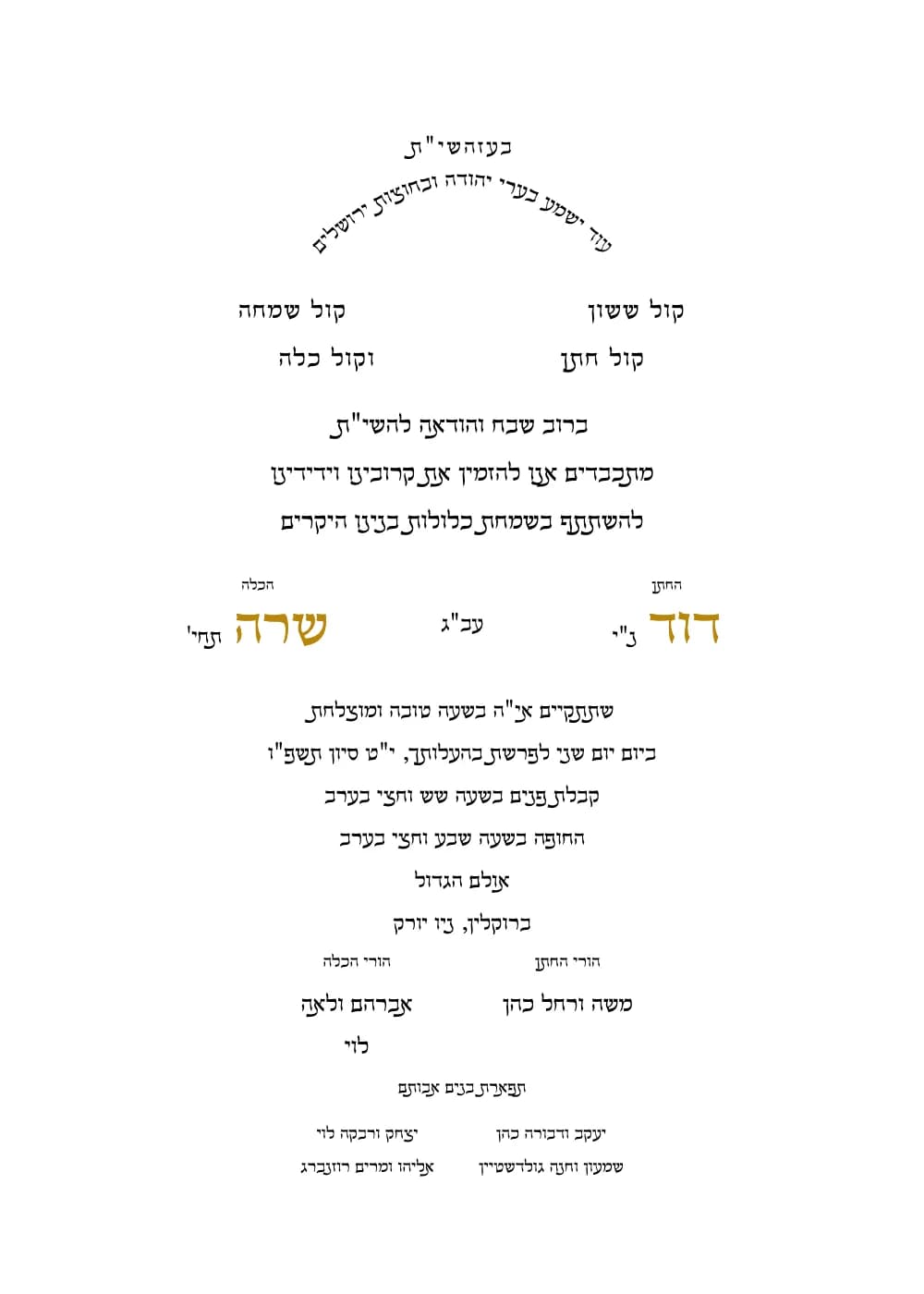
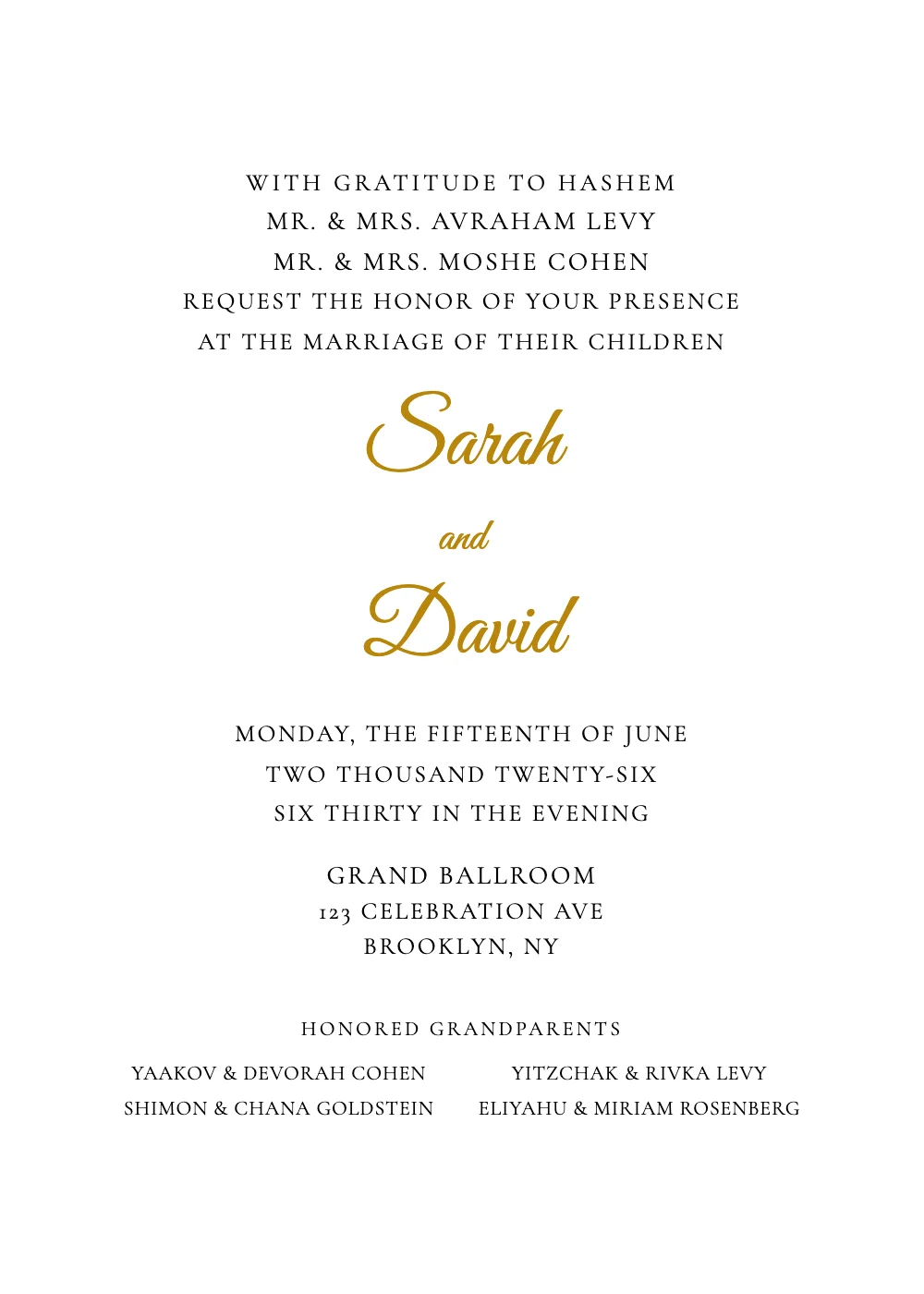
A traditional Hebrew wedding invitation may be only a few lines long, but those lines can carry thousands of years of Jewish language.
The familiar opening, קול ששון וקול שמחה, קול חתן וקול כלה, comes from the prophet Jeremiah and appears again in the final blessing recited under the chuppah. Other invitations begin with words from the Torah’s account of Yitzchak and Rivkah, a phrase from the Talmud, or a simple expression of gratitude to Hashem. Even the way the parents and couple are listed tells a story about how Jewish wedding invitations have changed.
This guide explains where the traditional wording comes from, what the common Hebrew abbreviations mean, and how to write a Hebrew, English, or bilingual Jewish wedding invitation that feels authentic to your family.
Is There One Correct Hebrew Wedding Invitation Text?
No. A wedding invitation is not a halachic document like a ketubah, and there is no single required formula.
What exists instead is a collection of conventions. Families choose among them according to community, family custom, language, and style. A formal yeshivish invitation, a Sephardi invitation, a Modern Orthodox bilingual invitation, and a contemporary Israeli invitation may look very different while all remaining recognizably Jewish.
Most traditional invitations contain some version of five elements:
- A heading, blessing, or biblical phrase
- An expression of gratitude or joy
- The names of the couple and, often, their parents
- The Hebrew date, civil date, time, and location
- Practical details such as kabbalat panim, chuppah, dinner, and RSVP information
The wording is flexible. The information cannot be.
A Short History of the Jewish Wedding Invitation
Jewish marriage is ancient. The printed wedding card is not.
Invitations were meant to be used and discarded, so early examples rarely survived. The Center for Jewish Art describes early wedding invitations as unusually scarce pieces of ephemera. Its Gross Family Collection includes an ornate Hebrew invitation printed in Jerusalem in 1881, headed בסימן טוב ובמזל טוב. The invitation joined an Ashkenazi groom and a Sephardi bride and was produced by Avraham Moshe Luncz, one of Jerusalem’s early Hebrew printers. View the 1881 invitation in the Center for Jewish Art collection.
The earliest wedding invitation preserved in the National Library of Israel’s own invitation collection dates to 1883. In it, Moshe Fishel invites relatives and acquaintances to the wedding of his grandson. That is not proof that it was the first printed Jewish wedding invitation, only that it is the earliest one in that collection. The National Library’s survey of its wedding invitation collection shows how much the form changed afterward.
Early twentieth-century invitations often treated the wedding as a union of two families in a very literal typographic way. The bride’s and groom’s families appeared separately, each inviting its own guests. Later, the two families were presented together. By roughly the 1970s, Israeli invitations increasingly named the couple themselves as the hosts.
The venue changed too. Older invitations commonly named a family courtyard or hotel. Purpose-built wedding halls began to appear more regularly in the 1960s. Graphic designers had a growing influence in the 1970s, producing invitations shaped like calendar pages, ketubot, and other creative forms. At the same time, many Haredi invitations retained a formal, text-centered style closely resembling earlier Jerusalem examples.
Today’s invitation may arrive by mail, email, text, or WhatsApp, but its structure is still familiar: sacred language at the top, family and couple at the center, and the details of the celebration below.
Why “Kol Sasson V’Kol Simcha” Appears on Wedding Invitations
The most recognizable Hebrew wedding invitation wording is:
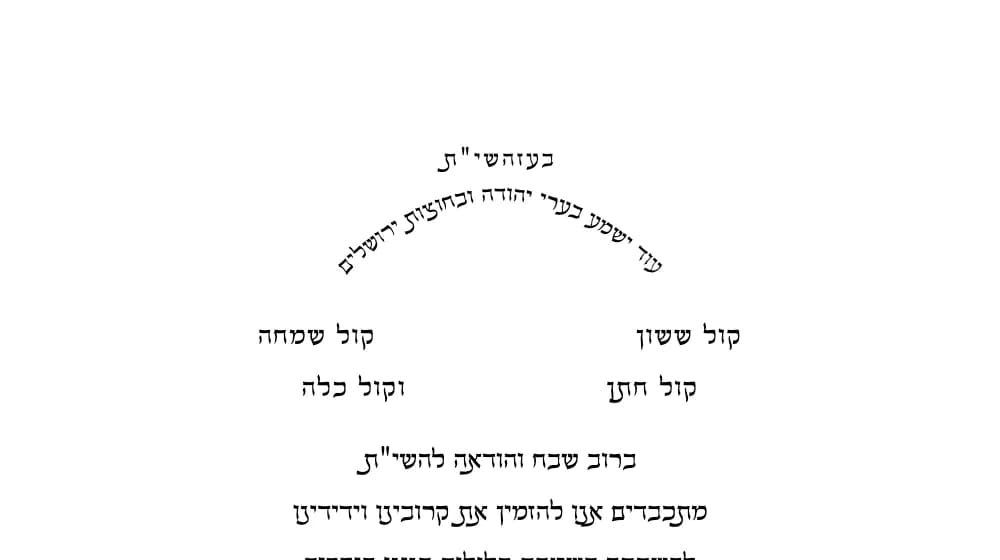
קול ששון וקול שמחהקול חתן וקול כלהKol sasson v’kol simcha, kol chatan v’kol kallah means “the voice of joy and the voice of gladness, the voice of the groom and the voice of the bride.”
The words come from Jeremiah 33:10–11. In context, they are part of a promise that joy, marriage, and thanksgiving will once again be heard in the cities of Judah and the streets of Jerusalem. That context gives the phrase more weight than a decorative wedding slogan. A new marriage becomes part of the Jewish people’s larger story of continuity and rebuilding.
The same passage was incorporated into the final of the Sheva Brachot, the seven wedding blessings recorded in Ketubot 8a. The blessing expands the verse into a prayer for joy, love, friendship, peace, and the sounds of bride and groom rejoicing under the chuppah.
This also explains two variations commonly seen on invitations:
- עוד ישמע means “there shall yet be heard” and follows Jeremiah’s wording.
- מהרה ישמע means “may there soon be heard” and follows the language of the wedding blessing.
Both belong naturally at a Jewish wedding. They come from related, but not identical, texts.
Why Is “Kol Sasson” Arranged in an Arch or Separate Stacks?
On some invitations, the verse becomes part of the artwork. Its four parallel phrases lend themselves to a balanced layout: קול ששון and וקול שמחה, followed by קול חתן and וקול כלה. Designers may curve the words into an arch or arrange them in matching stacks on either side. The result frames the invitation and can resemble a crown or canopy. Those visual associations should be understood as interpretations of the design, rather than a documented origin or required religious arrangement.
Other Traditional Hebrew Phrases and Where They Come From
בסימן טוב ובמזל טוב
B’siman tov u’v’mazal tov means “with a good sign and good fortune.” It is both a blessing and an announcement that something joyful is beginning. The phrase appears as the heading of the preserved 1881 Jerusalem invitation described above and remains common, especially on traditional and Sephardi-style invitations.
מה׳ יצא הדבר
MeiHashem yatza hadavar, “the matter came from Hashem,” comes from Genesis 24:50. Lavan and Betuel say it after hearing how Avraham’s servant was led to Rivkah as a wife for Yitzchak. On an invitation, the phrase expresses the belief that the match is guided by Divine providence.
ענבי הגפן בענבי הגפן, דבר נאה ומתקבל
Anvei hagefen b’anvei hagefen, davar na’eh u’mitkabel compares a fitting match to “grapes of the vine with grapes of the vine.” The expression comes from Pesachim 49a. It is a more learned and less universally used heading, but it has a long association with an appropriate shidduch.
מצא אשה מצא טוב
Matza ishah matza tov, “one who has found a wife has found goodness,” comes from Proverbs 18:22. It works well as a short heading, though its wording is naturally centered on the groom.
אני לדודי ודודי לי
Ani l’dodi v’dodi li, “I am my beloved’s and my beloved is mine,” comes from Song of Songs 6:3. It is especially popular on contemporary invitations because it is short, mutual, and immediately understood as an expression of love.
What the Common Hebrew Abbreviations Mean
Traditional invitations can seem crowded with initials. Most are blessings or respectful titles, not part of the couple’s names.
| Abbreviation | Full phrase | Meaning and use |
|---|---|---|
| בס״ד | בסייעתא דשמיא | “With the help of Heaven,” often placed at the upper right |
| בע״ה | בעזרת השם | “With Hashem’s help” |
| אי״ה | אם ירצה השם | “If Hashem wills,” often used before the date or chuppah details |
| נ״י | נרו יאיר | “May his light shine,” commonly written after a groom’s name |
| תחי׳ | תחיה | “May she live,” commonly written after a bride’s name |
| הי״ו | השם ישמרהו ויחייהו | “May Hashem protect him and give him life” |
| שליט״א | שיחיה לאורך ימים טובים אמן | A formal honorific, most often used for a living rabbi |
| ז״ל | זכרונו לברכה / זכרונה לברכה | “Of blessed memory,” after the name of someone deceased |
| עב״ג | עם בת גילו | “With his bat gilo,” the destined match born under his mazal. The traditional connector between the groom’s and bride’s names, explained below |
Not every invitation needs these abbreviations. Using fewer of them is often better than adding titles you do not fully understand. Family and community practice should guide whether parents, grandparents, or rabbanim receive particular honorifics.
What “Im Bat Gilo” Really Means
עב״ג is short for עם בת גילו, and it is easy to translate too literally. In modern Hebrew, גיל means “age,” so the phrase reads as “with the daughter of his age,” a woman of his generation. On an invitation it carries an older meaning.
The Gemara in Nedarim 39b teaches that a visitor who is the patient’s בן גילו takes away one sixtieth of the illness, and the classical commentators explain ben gilo as someone born at the same time, under the same mazal, the same constellation. (A minority reading takes it as someone of the same age, which is where the modern gloss comes from.) A בת גילו is therefore the woman whose mazal matches the groom’s: his counterpart, the one who was meant for him. The phrase sits naturally beside the teaching in Sotah 2a that forty days before a child is formed, a heavenly voice announces בת פלוני לפלוני, “the daughter of so-and-so for so-and-so.” When an invitation says the chatan is marrying עם בת גילו, it is quietly saying that this match was made in Heaven. In everyday terms, she is his bashert.
The phrase is one-directional: it describes the bride relative to the groom, and there is no conventional mirror image describing the groom relative to the bride. That is one reason some couples prefer the paired heart-choice wording in the next section, which gives both sides a phrase of their own.
“Im Bechirat Libo” and “Im Bechir Libah”: The Circular Arrangement
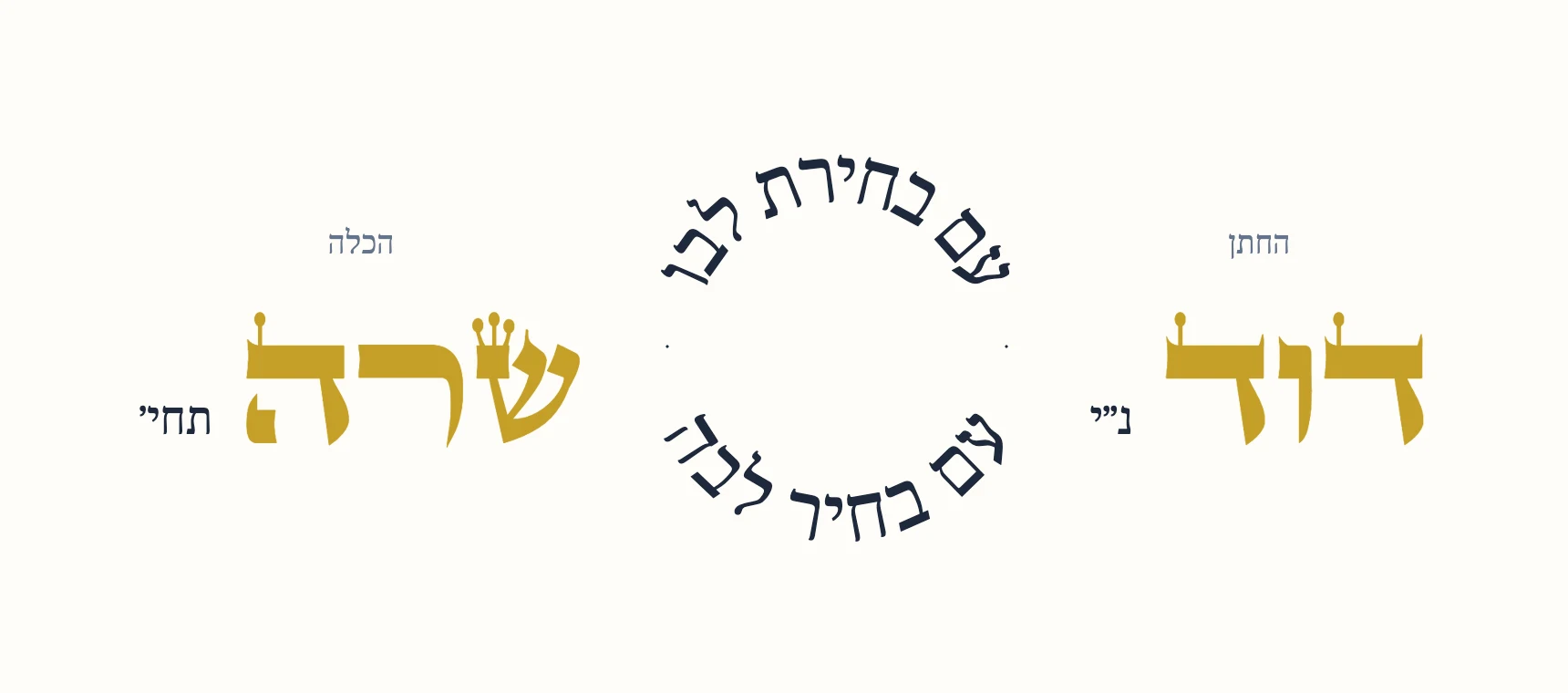
Some Hebrew invitations connect the couple’s names with two complementary phrases, arranged as a small circle or paired curved lines between the names:
| Hebrew wording | Transliteration | Meaning |
|---|---|---|
| עם בחירת לבו | Im bechirat libo, or Ashkenazi im bechiras libo | “With the woman his heart has chosen” |
| עם בחיר לבה | Im bechir libah | “With the man her heart has chosen” |
The wording changes in both places: בחירת refers to the woman chosen, while בחיר refers to the man; לבו means “his heart,” while לבה means “her heart.” You may also see the fuller spellings ליבו and ליבה. The abbreviation עב״ל can represent either phrase, depending on the direction of the sentence.
Read from the groom toward the bride, the connection is עם בחירת לבו. Read from the bride toward the groom, it is עם בחיר לבה. A circular arrangement lets the design express both readings, rather than giving only one person the grammatical role of choosing. The circle visually links the names, but the wording still needs to follow the correct person in each direction.
Who Uses This Wording?
This is a contemporary invitation convention, suited to couples who want Hebrew wording that explicitly expresses mutual choice. It can be used on Modern Orthodox and other contemporary bilingual invitations, but it should not be presented as a required or exclusive custom of one community. A discussion of Hebrew invitation abbreviations on Mi Yodeya documents the use of the heart-choice wording in both directions on modern invitations. It does not establish which community originated the circular design or how widely each community uses it.
For your own invitation, choose the paired wording if its mutual sentiment and circular layout appeal to you. Families following a more formal inherited layout may prefer עב״ג, discussed above. Neither connector is a required formula for an invitation.
Design tip: Proofread each phrase together with the names it connects. Rotating or curving the text should never reverse the Hebrew letter order or accidentally give the bride בחירת לבה when the intended meaning is “the man her heart has chosen.”
Traditional Orthodox Hebrew Wedding Invitation Wording
Here is a flexible traditional template. Replace the bracketed text and adjust titles to match your family’s practice.
בס״דקול ששון וקול שמחה, קול חתן וקול כלהבשבח והודאה להשי״תהננו מתכבדים להזמין אתכם להשתתףבשמחת כלולות ילדינו היקריםהחתן [שם החתן] נ״יעב״גהכלה [שם הכלה] תחי׳שתתקיים אי״ה ביום [יום בשבוע], [תאריך עברי]למניינם [תאריך לועזי]קבלת פנים בשעה [שעה]החופה בשעה [שעה]באולם [שם המקום], [כתובת]נשמח לראותכם בין אורחינו[שמות הורי החתן][שמות הורי הכלה]This version is formal without trying to imitate every convention of a particular kehilla. Some families use בננו ובתנו instead of ילדינו, some place the parents’ names above the couple, and some list the two families in separate columns.
For a very traditional invitation, have someone familiar with your community review titles, name order, and family references before sending it.
Bilingual Hebrew and English Wedding Invitation Wording
The English side does not have to be a word-for-word translation of the Hebrew side. It should communicate the same hosts, couple, date, location, and schedule in natural English.
With gratitude to Hashem[Parents of the groom]and[Parents of the bride]invite you to share in the simchaof the marriage of their children[Groom’s name] and [Bride’s name]on [day of week], [civil date]corresponding to [Hebrew date]Kabbalat Panim at [time]Chuppah at [time][Venue name][Address]“Invite you to share in our simcha” usually sounds warmer and more recognizably Jewish than the conventional “request the honor of your presence.” Either is acceptable, but they create different tones.
If the Hebrew and English sides use different everyday names, make sure guests can still recognize the couple. For example, the Hebrew side may use full Hebrew names while the English side uses the names by which friends know them.
Browse SimchaMaker’s Hebrew and English wedding invitation designs to see how bilingual wording can fit naturally into a traditional layout.
A Sephardi-Inspired Hebrew Wedding Invitation Example
There is no single Sephardi wording. Moroccan, Syrian, Persian, Turkish, Iraqi, and other communities have their own family and local customs. Still, בסימן טוב ובמזל טוב is a natural opening for a warm, traditional invitation.
בסימן טוב ובמזל טובבשמחה ובהודיה לה׳[שמות ההורים] ו-[שמות ההורים]מתכבדים להזמינכם לשמחת נישואי ילדיהם[שם החתן] ו-[שם הכלה]ביום [יום בשבוע], [תאריך עברי]קבלת פנים בשעה [שעה]חופה וקידושין בשעה [שעה][שם האולם והכתובת]Treat this as a starting point, not as a substitute for a family minhag. If your family has a familiar phrase or ordering used on earlier invitations, preserving it may matter more than choosing a supposedly universal “Sephardi” template.
Modern Israeli Hebrew Wedding Invitation Wording
Contemporary Israeli invitations are often shorter and more couple-centered:
אנחנו מתחתנים![שם הכלה] ו-[שם החתן]שמחים להזמין אתכם לחגוג איתנוביום [יום בשבוע], [תאריך]קבלת פנים [שעה] | חופה [שעה][שם המקום], [עיר]נשמח לראותכםנא אשרו הגעהAnother common closing is נא לראות הזמנה זו כאישית, “Please consider this a personal invitation.” It developed naturally in an era when one printed or forwarded invitation might reach a large circle.
How to Write the Hebrew Date Correctly
A traditional invitation usually includes both the Hebrew and civil dates. The Hebrew date should include:
- The day of the week
- The day of the Hebrew month
- The Hebrew month
- The year, if desired
For example:
ביום שלישי, י״ד באדר תשפ״זRemember that the Hebrew date changes at sunset, not at midnight. A chuppah held after nightfall may fall on the next Hebrew date even though the civil date has not changed. This is one detail worth confirming before printing or sending hundreds of invitations. The same catch applies when you are choosing the date in the first place: see which dates the Jewish calendar allows for a wedding.
SimchaMaker can calculate the Hebrew date, day of the week, and weekly parsha from your wedding details, then place them into a properly right-to-left layout. You can still review and edit the result to match your family’s preferred style.
Should You Write Hashem’s Name or a Full Pasuk?
This is partly a design question and partly a halachic one.
Some families freely use a biblical verse or a Divine name on an invitation. Others avoid doing so because printed invitations are often discarded, which can create a question of genizah, or respectful disposal. Abbreviations such as בס״ד, בע״ה, אי״ה, ה׳, and השי״ת are common ways of expressing faith without spelling a Divine name in full.
There are also differing halachic views about when a complete or partial verse makes an invitation require genizah. This summary from Din Online illustrates why families with a particular practice should ask their rav before printing a full pasuk or Divine name.
For a digital-only invitation, physical disposal is not the same practical concern, but families may still prefer the same wording they would use in print.
Details Every Jewish Wedding Invitation Should Make Clear
Beautiful Hebrew wording cannot rescue unclear logistics. Before sending, check that guests can quickly find:
- The couple’s recognizable names
- The correct civil and Hebrew dates
- The venue name and full address
- Kabbalat panim or reception time
- Chuppah time
- Dinner time, if it is separate or relevant
- Which portions of the wedding each guest is invited to attend
- RSVP method and deadline
- Dress, transportation, or security details, if needed
For a frum wedding, “6:30 p.m.” may refer to kabbalat panim, the chuppah, or dinner. Label each event part rather than making guests guess.
A digital invitation can also let each guest RSVP to the correct portions of the event. See how SimchaMaker handles chuppah, reception, dinner, and per-part headcounts.
Common Hebrew Wedding Invitation Mistakes
Translating too literally
The Hebrew and English sides should agree, but they do not need identical syntax. Natural Hebrew on one side and natural English on the other will read better than a rigid line-by-line translation.
Treating Hebrew like left-to-right text
Hebrew punctuation, numbers, honorifics, and mixed-language addresses can reorder themselves in a generic design tool. Use a layout that properly supports right-to-left text and inspect every line.
Guessing at honorifics
Adding more initials does not make an invitation more authentic. An incorrect title can be more awkward than no title at all.
Using the wrong Hebrew date
This often happens when the chuppah is after sunset or when a converter and venue schedule are working from different assumptions.
Hiding the chuppah time
Guests should not have to infer it from the reception time. If the bedeken, chuppah, and dinner are separate parts, say so clearly.
Forgetting how the invitation will be read on a phone
Fine print that looks elegant on a large proof may be unreadable in a text message. Test both the Hebrew and English sides on an actual phone before sending.
Frequently Asked Questions
What does “Kol Sasson V’Kol Simcha” mean?
It means “the voice of joy and the voice of gladness.” The fuller phrase continues, “the voice of the groom and the voice of the bride.” It comes from Jeremiah 33:10–11 and is echoed in the final wedding blessing.
Does a Jewish wedding invitation need Hebrew?
No. Hebrew is traditional and meaningful, but it is not required for an invitation to be valid. Choose the languages your guests and family will understand. Many Orthodox families prefer a full Hebrew side and a full English side.
Whose names go first on a Jewish wedding invitation?
There is no universal rule. Traditional layouts may follow a community’s established order, while modern invitations often choose the arrangement that reads or looks best. Consistency and family sensitivity matter more than a supposed universal etiquette rule.
Should both sets of parents be listed?
Usually, especially in Orthodox invitations, but the exact wording depends on who is hosting and on family circumstances. Couples may list both sets of parents, use “together with their parents,” name the couple as hosts, or include grandparents as well.
How do you mention a deceased parent?
The person’s name may be followed by ז״ל, with the surviving parent listed in a way that feels natural and respectful. Because family preferences differ, this wording should be reviewed carefully before sending.
Is “Chuppah” capitalized in English?
Either style can work. “Chuppah” is common in invitations because it names a specific event in the schedule. More important than capitalization is using one spelling consistently. Common spellings include chuppah and chupah.
Can the invitation include RSVP details in Hebrew?
Yes. נא אשרו הגעה means “please confirm attendance.” On a bilingual invitation, it is often clearer to provide the RSVP button or instructions in both languages.
A Tradition That Still Has Room for Your Voice
The Hebrew wedding invitation has never been one fixed text. Its printed form has changed with technology, family structure, venue customs, and design. Its most beloved words, however, still connect a wedding today to Jeremiah’s promise that Jewish joy will continue to be heard.
Start with the tradition that feels like yours. Keep the practical details unmistakable. Then let the invitation sound like the family and marriage it is announcing.
Create a Hebrew and English Jewish wedding invitation with SimchaMaker. The Hebrew date, traditional wording, honorifics, right-to-left layout, digital delivery, and RSVP flow are built in, and every line remains customizable.