What Is the Best Day of the Week for a Jewish Wedding?
By SimchaMaker
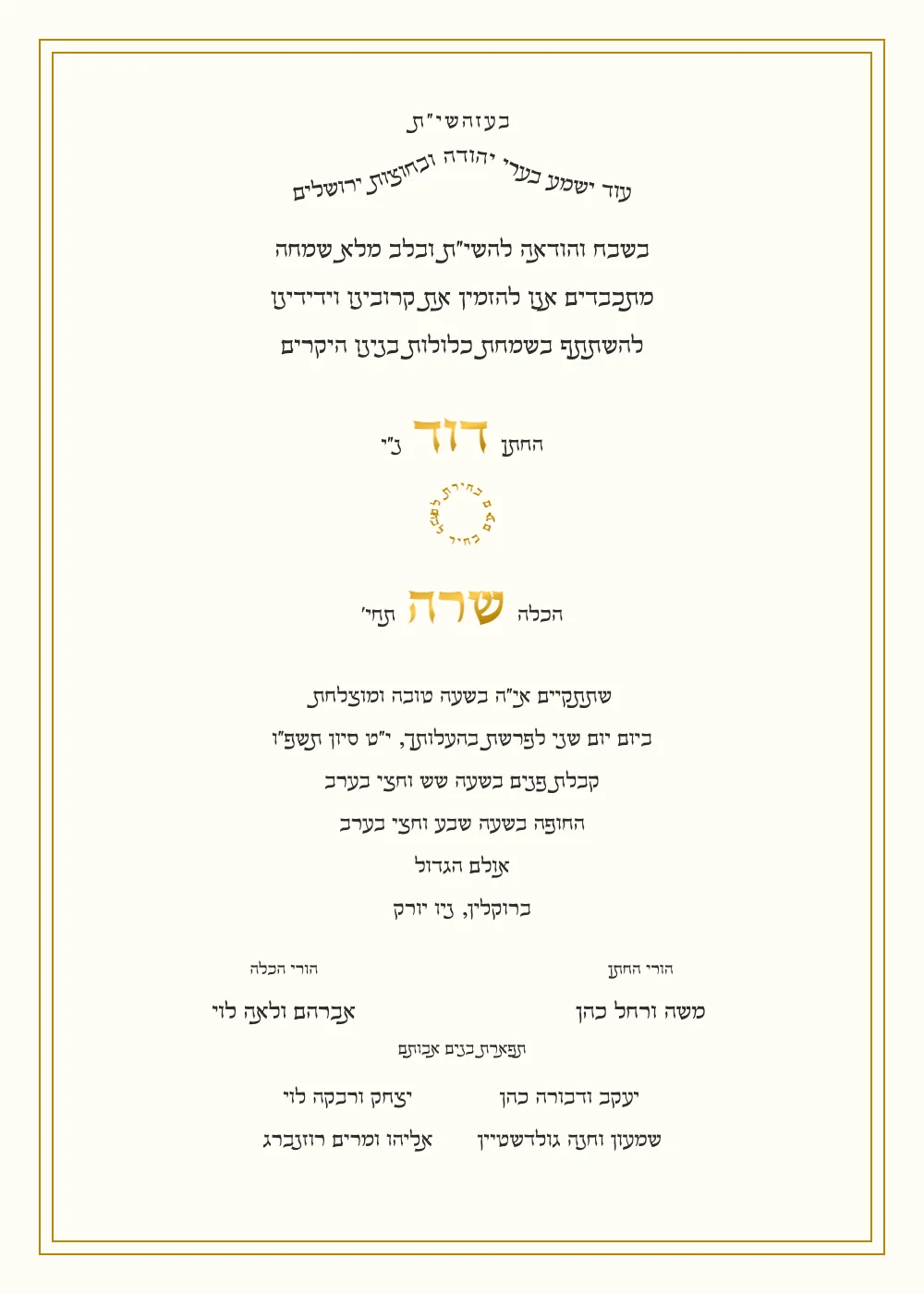
Almost every Jewish couple has heard that Tuesday is the lucky day, because the Torah says כי טוב, “it was good,” twice on the third day of Creation.
The custom is real and widely kept. The explanation is not what the Talmud says. When the Gemara discusses why Jews began marrying on Tuesday, it gives a completely different reason, and it is a much darker one.
That gap between the reason everyone gives and the reason in the source is a good picture of this whole subject. Once a couple has cleared the calendar restrictions, Shabbat, Yom Tov, Sefirat HaOmer, the Three Weeks, there is a second layer of Jewish tradition about which of the permitted days is actually preferable. Some of it is Talmudic law. Some of it is later custom. Some of it is folklore that grew up on top of both.
This guide separates the three. If you have not yet worked through the restrictions themselves, start with our guide to when Jews can get married. This article assumes the date is already permitted and asks only whether it is a good one.
The Week, Day by Day
| Day | Where it stands | What tradition says |
|---|---|---|
| Sunday | The most common day today | Classical sources restrict it. Later custom set that aside, and convenience did the rest |
| Monday | Permitted, like any other day | The only day of Creation with no “ki tov,” which is a fact about the text rather than a rule about weddings |
| Monday night | Very popular | Already Tuesday by the Hebrew date, at a Monday price |
| Tuesday | Considered auspicious | “Twice it was good” in Creation. The Gemara’s own reason for Tuesday is the era of persecution |
| Wednesday | Fine | The Mishnah’s day for a first marriage, for reasons of court schedules and preparation time |
| Thursday | Fine, and some prefer it | The Mishnah’s day for a widow. The Pnei Yehoshua holds the Creation blessing is still worth aiming for |
| Friday | Permitted, heavily seasonal | Accepted custom permits it when the feast was prepared in advance |
| Motzaei Shabbat | Permitted, and some discourage it | The Shabbat-preparation concern applies here more strongly than to Sunday |
The Mishnah’s Rule: Wednesday and Thursday
Mishnah Ketubot 1:1 opens with a remarkably specific rule:
בתולה נשאת ליום הרביעי ואלמנה ליום החמישי
A previously unmarried woman was married on Wednesday, and a widow on Thursday. That sounds like the Mishnah is naming especially lucky wedding days. It is not.
Why Wednesday?
The Mishnah gives its own reason, and it is legal rather than mystical. Local courts sat twice a week, on Monday and Thursday. A first marriage was scheduled for Wednesday so that if the husband had a claim about the bride’s virginity, he could bring it to beit din the very next morning, before his anger cooled and before evidence grew stale.
The Gemara then asks the obvious question: if that is the reason, why not Sunday, which is also followed by a court day? The answer is a second, practical consideration. The Sages wanted the groom to spend Sunday, Monday, and Tuesday preparing the wedding feast properly rather than rushing it. See Ketubot 3b.
And once courts sat every day, the Gemara says plainly that a woman may be married on any day of the week. See Ketubot 3a.
So Wednesday was never “the lucky day.” It was the day that made the legal system work, and the rule expired with the circumstances that produced it.
Why Thursday for a Widow?
Here the reasoning has two parts. The practical one: a man marrying a widow does not observe the seven days of celebration that follow a first marriage, so he would otherwise be back at work the next morning, leaving his wife alone. A Thursday wedding gave the couple three consecutive days together: Thursday, Friday, and Shabbat. See Ketubot 5a.
That preference did not entirely disappear. The Pitchei Teshuva cites the Pnei Yehoshua, who is astonished that the Tur and the other authorities say a woman may now marry on any day without noting that one should still ideally aim for the blessing, and who concludes that whoever wishes to fulfill the words of the Sages should be mindful of it. See Pitchei Teshuva, Even HaEzer 64:6. Which blessing he means is the subject of the next section.
The Creation Blessings: Fish, Adam, and Fertility
Bar Kappara taught that a first-time bride was married on Wednesday and the marriage was consummated on Thursday, because the blessing of fruitfulness was given to the fish on the fifth day of Creation. A widow was married on Thursday and the marriage consummated on Friday, because the blessing of procreation was given to human beings on the sixth day. See Ketubot 5a.
So the Talmud itself does contain the idea of aligning the start of a marriage with a day on which a biblical blessing of fertility was pronounced.
But notice what the blessing is actually attached to. It is the night the marriage is consummated, not the date printed on the invitation. This distinction is almost always lost when the tradition is repeated, and it matters: it means the Talmud’s own “auspicious day” material is not really about picking a wedding date at all.
The historical arrangement is preserved in Shulchan Aruch, Even HaEzer 64:3, even though wedding schedules no longer follow those weekday rules.
Tuesday and פעמיים כי טוב
This is the best-known Jewish wedding-day tradition today, and the most misunderstood.
On the third day of Creation, the Torah says כי טוב, “it was good,” twice, at Genesis 1:10 and Genesis 1:12. No other day of Creation has it twice. That gave rise to the familiar expression:
יום שלישי, פעמיים כי טוב
“Tuesday, twice it was good.” Many couples accordingly regard Tuesday as a particularly auspicious wedding day, and many families keep it.
It is a lovely custom. It is simply not the reason the Talmud gives. When the Gemara explains how Tuesday weddings began, it points to persecution. A decree required a Jewish bride married on Wednesday to be violated by the local official first, so the community began marrying on Tuesday instead, and the Sages did not oppose the change. See Ketubot 3b.
Rabbi Dr. Ari Z. Zivotofsky traces the later history of the custom in “Tzarich Iyun: Tuesday Weddings”, noting that while Tuesday is certainly a fine day to marry, the pa’amayim ki tov explanation does not appear in the classical sources that set preferred wedding days.
None of that makes the custom wrong. A siman bracha does not need a Talmudic pedigree to be meaningful. It just means Tuesday is a beloved later custom rather than an ancient requirement, and a couple who cannot get Tuesday has not lost anything halachic.
The Monday Night Trick
A Jewish day begins at night. A wedding held on Monday evening, after nightfall, is already taking place on Tuesday by the Hebrew date.
So a Monday night chuppah can be a genuine יום שלישי, פעמיים כי טוב wedding at a Monday night price. This is not a loophole; it is simply how the Hebrew date works, and it is why so many Orthodox weddings are held on Monday and Tuesday evenings.
The same shift applies to every night of the week, and it is worth keeping straight whenever one of these customs matters to you. A Sunday night chuppah is Hebrew Monday. A Saturday night one is Hebrew Sunday. Every evening wedding belongs to the day whose name is one ahead of the one on the venue contract.
Is Monday a Bad Day?
Monday is conspicuous in the Creation account: it is the only day on which כי טוב is not said at all. People sometimes take that as a reason to avoid a Monday wedding.
Nothing in the sources supports that.
There is one Talmudic line that looks as though it might, and it is worth understanding because it does get quoted. The same baraita that permits the shift to Tuesday continues that on Monday one may not marry, though it is permitted under actual coercion. See Ketubot 3b.
Read in context, that is a limit on the emergency concession rather than a statement about Monday. Rashi explains it exactly that way: it means on account of that danger, and there is no need to uproot the Sages’ enactment by more than a single day, so that the groom still has at least two days to prepare the feast. The sentence is about how far the license stretches, not about whether Monday is a good day to marry.
And the framework it belongs to has itself lapsed. The Arukh HaShulchan writes that the grievance the Mishnah was addressing no longer arises, since kiddushin and nisuin now take place together, that courts no longer sit only on Monday and Thursday, and that a groom who has already prepared may marry even on Sunday. His conclusion is four words: ולדידן בכל יום, and for us, any day. See Arukh HaShulchan, Even HaEzer 64:6.
So Monday is permitted, and there is no more reason to seek it out than to avoid it.
One thing is worth being careful about here, because it runs the opposite way to what people assume. “Monday wedding” normally means the civil weekday, but the day the sources are naming begins the evening before. The evening stretch of Hebrew Monday is Sunday night. So an evening chuppah held after nightfall on a Sunday is already taking place on Hebrew Monday, which is one of the most heavily used wedding slots in the Orthodox world rather than an empty one. Had there been a live restriction on Monday, it would land squarely there, not on the rare Monday daytime wedding. It is the reason the question is worth settling rather than waving away.
In the Mishnah’s world the label and the day lined up, because weddings were daytime events. A bride was married on the fourth day and the marriage consummated on the fifth, בתולה נשאת ברביעי ונבעלת בחמישי, which is to say she married on Wednesday and the night that followed was already counted as Thursday. See Ketubot 5a. Once weddings moved to the evening, the civil label and the Hebrew day came apart, and they have stayed apart since.
What About Sunday?
There is no Jewish law requiring a wedding to be on Sunday, and the classical sources lean the other way.
The Rambam records that weddings were not held on Friday or Sunday, out of concern that preparing the feast could lead to Shabbat desecration on one side of Shabbat or the other. See Mishneh Torah, Hilchot Ishut 10:14.
There was a second and separate objection. The Pitchei Teshuva, citing a responsum of the Rema, records that it is not the way to hold weddings on Sunday because it follows gentile practice. See Pitchei Teshuva, Even HaEzer 64:4. That concern is not generally treated as an issue today, as Zivotofsky discusses in the article above.
Shulchan Aruch, Even HaEzer 64:3 records both the stringent and the lenient views and notes that the accepted custom is lenient, and that is where the matter rests.
So Sunday’s enormous popularity in Orthodox communities is not a statement about Sunday. It is pure convenience: Shabbat is over, guests do not need to leave work early, the celebration cannot run into Friday night, and vendors have had a full day to prepare.
What About Friday?
Friday weddings are permitted. The accepted custom in Shulchan Aruch, Even HaEzer 64:3 allows a Friday wedding provided the groom prepared the feast during the preceding days, which answers the Rambam’s concern.
Whether a Friday wedding is practical depends almost entirely on the season. When sunset is late, a Friday afternoon chuppah and meal can work beautifully, and the celebration flows straight into Shabbat. When Shabbat begins shortly after 4:00 p.m., the same plan looks very different.
What About Saturday Night?
Once Shabbat has ended, Saturday night is available, and it is a common winter choice. But it is worth knowing that this is the one popular weekday slot that carries a halachic reservation of its own, which most couples have never heard.
The Gemara discusses a concern about marrying at the conclusion of Shabbat, and Rabbi Zeira explains it as a decree lest someone slaughter a bird on Shabbat itself in his preoccupation with that night’s wedding feast. See Ketubot 5a.
The practical upshot is a mirror image of Sunday. The Shabbat-preparation worry that later practice dismissed for Sunday weddings applies more directly to motzaei Shabbat, when the event genuinely does follow straight on from Shabbat. Some authorities accordingly hold that a motzaei Shabbat wedding, while technically permitted, is better avoided, and Chacham Ovadia Yosef worked to discourage them during his years as chief rabbi of Tel Aviv, as Halachipedia’s summary of scheduling a wedding date records.
Plenty of communities hold motzaei Shabbat weddings anyway. The point is that the objection is real, so it belongs in the conversation with your rabbi rather than being discovered afterward.
One more calendar quirk: because the Jewish day begins at night, a Saturday night wedding is already taking place on Sunday by the Hebrew date. The invitation will say so.
The Moon: A Custom You May Not Have Heard Of
Weekdays are not the only place Jewish tradition looked for a good sign.
The Rema records a custom of marrying during the earlier part of the Jewish month, while the moon is growing toward fullness. See Shulchan Aruch, Even HaEzer 64:3. The symbolism is easy to read: beginning a marriage while the moon is increasing stands for growth and blessing.
Three things are worth adding, because this custom is sometimes presented with more force than it carries. Later authorities, including the Arukh HaShulchan and Rav Moshe Feinstein, note that most people today do not follow it. The responsum Yehuda Yaaleh holds that a couple certainly should not postpone a wedding for it. And the Pnei Yehoshua, in the passage cited above, puts the question sharply: how is this sign, which is not mentioned in the Gemara at all, to be preferred over the reason of blessing, which is a baraita of Bar Kappara?
That is the whole subject in one sentence. Jewish wedding-day tradition is layered, the layers are not equal, and the loudest custom is not always the oldest one.
So What Is the Best Day?
Taken together, these traditions say something useful about how Jewish dates get chosen.
Jewish law establishes when a wedding may and may not take place. That part is not negotiable, and it comes first. But once a couple is choosing among permitted dates, Jewish tradition offers a second layer that is made of symbolism and good signs rather than obligations, and that layer is meant to be chosen from rather than obeyed.
For one family that means Tuesday, for פעמיים כי טוב. For another it means Rosh Chodesh, or the first half of the month, or a grandparent’s yahrzeit week, or a family date that means nothing to anyone else.
And for a great many couples it means the first otherwise permitted evening when the hall is free, the grandparents can travel, and the band is not already booked. That is not a lesser choice. None of these customs was ever meant to keep two people who are ready to marry waiting for a better-looking square on the calendar.
Frequently Asked Questions
Why do Jews get married on Tuesdays?
Because the Torah says כי טוב, “it was good,” twice on the third day of Creation, giving rise to the phrase פעמיים כי טוב. It is a later sign of blessing rather than a Talmudic rule. The Gemara’s own account of how Tuesday weddings started points to a period of persecution, not to Creation.
Did the Talmud specify wedding days?
Yes. Mishnah Ketubot 1:1 says a previously unmarried woman was married on Wednesday and a widow on Thursday. The reasons were the schedule of the rabbinical courts and ensuring enough time for preparation and celebration, with a secondary connection to the Creation blessings of fertility. Once courts sat daily, Ketubot 3a permits any day.
Is it bad luck to get married on Monday?
No. Monday is the only day of Creation on which כי טוב is not said, which is where the idea comes from, but no source turns that into a restriction. The one Talmudic line that names Monday limits an emergency concession rather than ruling on the day, and the Arukh HaShulchan concludes that in our time a wedding may be held on any day of the week. Note that Hebrew Monday runs from Sunday nightfall to Monday nightfall, so an evening chuppah on Hebrew Monday is a Sunday night wedding, not a Monday one.
Can a Jewish wedding be on Sunday?
Yes. The Rambam restricts Sunday weddings over Shabbat preparation, and the Pitchei Teshuva cites a responsum of the Rema objecting that it follows gentile practice, but the accepted custom set both concerns aside. Sunday is now the most common Orthodox wedding day for entirely practical reasons.
Is Saturday night a good time for a Jewish wedding?
It is common, especially in winter, but it carries a reservation the other days do not. The Shabbat-preparation concern that later practice dismissed for Sunday applies more directly to motzaei Shabbat, and some authorities hold that such weddings are better avoided. Worth raising with your rabbi.
Is there a best time of the month for a Jewish wedding?
The Rema records a custom of marrying in the first half of the month, while the moon is waxing, as a sign of growth. Later authorities note that most people no longer follow it and that a wedding should not be postponed for it.
Planning Your Jewish Wedding?
Once the date is settled, on the right day of the week, the right side of Shabbat, and the right half of the month, the next job is telling everyone.
SimchaMaker helps you create and send your Jewish wedding invitation and keep your RSVPs organized in one place.
Still working out whether your date is available at all? See when Jews can get married: Shabbat, Yom Tov, Sefirah, and the Three Weeks. And when you are ready to write the invitation, see our guide to Hebrew wedding invitation wording.